
How Sandpaper Letters Lead to the ‘Explosion of Writing’
Maria Montessori completely changed early education by seeing the child’s innate drive for self-construction. Her approach to teaching writing is another example of this philosophy in action. It moves beyond traditional, rote memorization, instead preparing children’s hands and minds needed for writing before the child ever picks up a pencil. This preparation ultimately leads to what she termed the “Explosion of Writing” in young children: the moment they suddenly start writing easily and spontaneously.
Montessori’s New Writing Approach
Maria Montessori’s approach to teaching written language was heavily learned by her foundational work with children with special needs, during which she studied the methods of Itard and Seguin. Both Itard and Seguin used highly structured, visual-motor methods mainly for children with intellectual disabilities. For example, Seguin believed if a child could trace and analyze abstract shapes like triangles and squares, they could eventually be able to write any letter.
However, Montessori criticized this approach because it failed to prepare both the child’s hand for the delicate work of writing, and the intellectual mind for word composition. Instead of focusing on the writing itself, Montessori focused on a psycho-physiological study of the writer. So she broke down the act of writing into two skills that must be prepared separately:
- The Hand Skill (Motor): the ability to hold the pencil and draw the letter shapes
- The Mind Skill (Intellectual): The ability to hear a word and break it down into the different sounds
3 Stages of Preparation for Writing
Montessori realized that a child does not write because their hand is unprepared to hold the pencil and their mind is unprepared to analyze sounds of the letters. The Montessori Method systematically prepares the child for writing through a process of indirect preparation and direct preparation.
- Indirect Preparation: Handling the Writing Instrument
This step focuses on developing the fine motor control and the three-finger pincer grip needed for holding a pencil, long before any formal writing instruction begins.
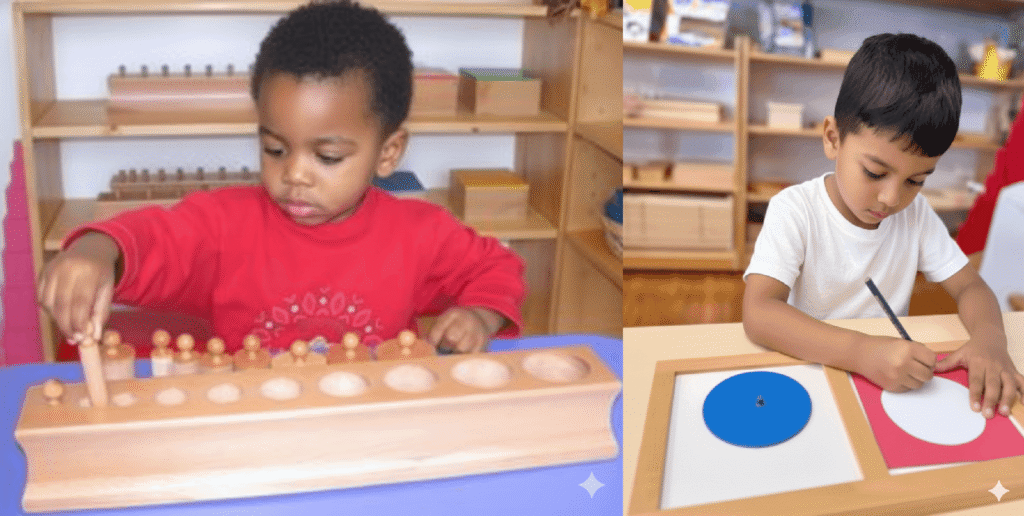
- Knobbed Cylinder: The child grasps the knob of the insets with the first three fingers. Through countless repetition, they develop the muscle memory for the proper pen grip.
- Metal Insets: The child uses the metal frame to trace geometric figures and then uses a colored pencil to fill in the outline almost the same as filling notebooks with lines, but they do it in a way that is engaging and fun.
- Direct Preparation: Drawing the Alphabetic Letters
Through this step, the child will fix the image and movement of the letters in their mind.
- Sandpaper Letters: The child traces the letters with the index finger of the dominant hand as if they were writing. They use three different senses (sight, touch and movement), creating the muscular memory. The letters are always taught using the phonetic sound (e.g., ‘mmm’ not ‘em’) rather than the letter name.
- Movable Alphabet: The child uses cut-out letters to compose words phonetically. This allows the child to focus only on analysing spoken language into its composition without worrying about the physical act of writing yet.
This sequenced preparation leads the child to the ‘Explosion of Writing.’ This is not magic; it is the result of a system where the hand and mind are fully prepared. When all the mechanical work is done in advance, writing starts being a natural way for the child to express themselves.
Tips for using Montessori Sandpaper Letters at Home
To ensure the material is used effectively outside of a prepared classroom environment, follow these key Montessori writing preparation guidelines:
- Teach the Phonetic sound: Focus on the phonetics of the letter, not its name.
- Use the Three-Period Lesson: Introduce the letter using the formal Three-Period Lesson.
| Naming | Teach names the sounds. | e.g., “This is ‘mmm’.” |
| Recognition | Ask the child to point to the letter. | e.g., “Show me the sound ‘mmm’.” |
| Recall | Ask the child to name the sound. | e.g., “What sound is this?” |
- Integrate Sight, Touch, and Movement: Always have the child trace the letter with their index and middle fingers of their dominant hand, tracing the letter in the correct direction.
Conclusion
Montessori focused on the psycho-physiological needs of the young writer. She created a powerful sequence for preparation of written language for a young learner. This path – from the indirect preparation of the hand, to the direct preparation of letter forms with the Sandpaper Letters, and finally to the intellectual work of the Movable Alphabet – separated the complexity of writing into manageable, sensory tasks. When the child is prepared correctly, writing becomes a natural, powerful way for them to express themselves.