
The way the child learns to write is usually a slow, tough process, with lots of wobbly lines here, a few letters there. The Montessori, however, describes something amazing: the Writing Explosion. This is when your child suddenly and perfectly produces written language. It happens all at once when the child is ready. It is not the result of direct teaching, but it’s the result of inner preparation within the child. The burst of writing is, without a doubt, a huge moment of pride, just as much as they felt when they said their first full word. Discover the three simple, indirect steps, allowing your child to start writing whole words easily and happily.
The 3 Steps that Get Your Child Ready to Write
The sudden, perfect ability to write comes from a method that breaks down the complex task of writing into three parts: Motor Control, Sensory Memory, and Thinking about Words. Instead of giving direct instruction, it focuses on mastering foundational mechanisms during the child’s sensitive period. When the child masters these three parts, the act of writing becomes easy because the child’s mind and body have been fully prepared.
Step 1: Motor Control – Learning to Hold the Pencil
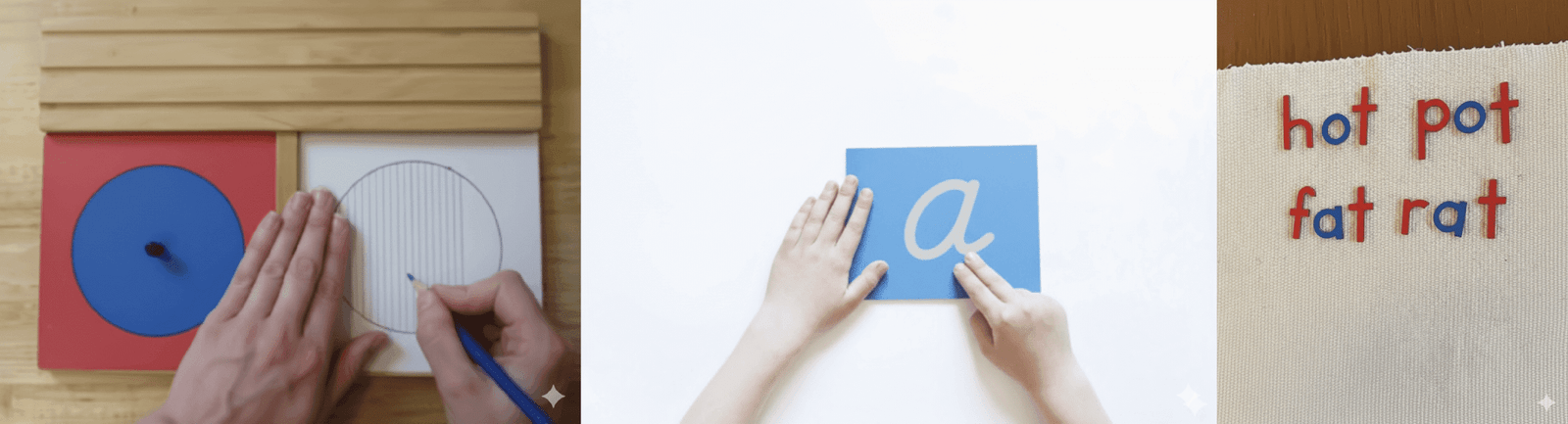
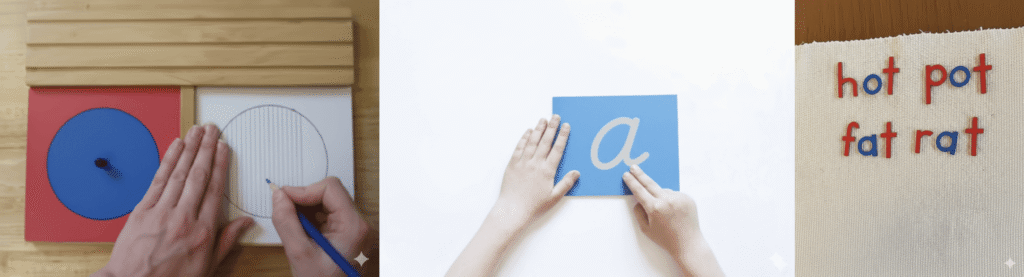
This stage is about developing the small muscle control needed to grasp and guide a pencil. The child uses Metal Insets (geometric drawing frames) to trace the geometric outlines and fills the figures with straight, regular lines. It helps develop motor memory in the hand, free from the writing of letters.
Step 2: Sensory Memory – Feeling the Letters
This very important step helps the child’s memory fix the exact shape of each letter. For this, the child uses their fingers to trace the Sandpaper Letters, which are letters made of tough sandpaper glued to smooth cards. This lets them see the letter, feel the letter, and feel the movement of drawing letters. By using three senses at once, the child stores the letter directly in their muscle memory. This makes the physical act of writing automatic later on.
Step 3: Thinking about Words – Building Words with Movable Alphabet
This step is all about training the child’s mind to hear the individual sounds that make up spoken words. It is an exercise free from the struggle of handwriting. For this, the child uses the Movable Alphabet, which is a set of small, cutout letter titles. They lay the letter tiles next to each other to build words they say out loud, matching the sounds they hear to the letter shapes. This helps the child analyze spoken language. because they joyfully discover that “the words we say are made up of sounds.” This is the last piece of the puzzle for the writing explosion.
Why Writing Happens Before Reading
In a Montessori setting, it’s common to see that a child writes before they read. This happens because writing is mostly about motor skills (using your hands and body), which is easier for a child during the sensitive period (about four years old). Reading, on the other hand, takes more abstract thinking to understand what the symbols mean and how they connect to meaning. Because the child’s hand is prepared and their mind understands the sounds, the mental signal to write is open, and the writing skill instantly bursts out.
Conclusion
The Montessori Explosion of Writing shows us the amazing, joyful power inside every child. By giving them the right tools at the right time, we step back and let the child follow their inner drive. For parents looking to support the final stage with the Movable Alphabet, the best tips are to focus on simple, short phonetic words (like C-A-T) and to treat the activity as a game. Also, keep this activity entirely separate from paper-and-pencil work so the child can focus on the sounds that make up their spoken language.